Giving Chain: How One Gift Can Keep Growing
12 min read · 2026-09-05
Opens the setup wizard. Sign in first if you are not already logged in. Organization admins can launch the campaign; members are guided to register or request admin access.
Five Loaves, Two Fish, and One Great Work
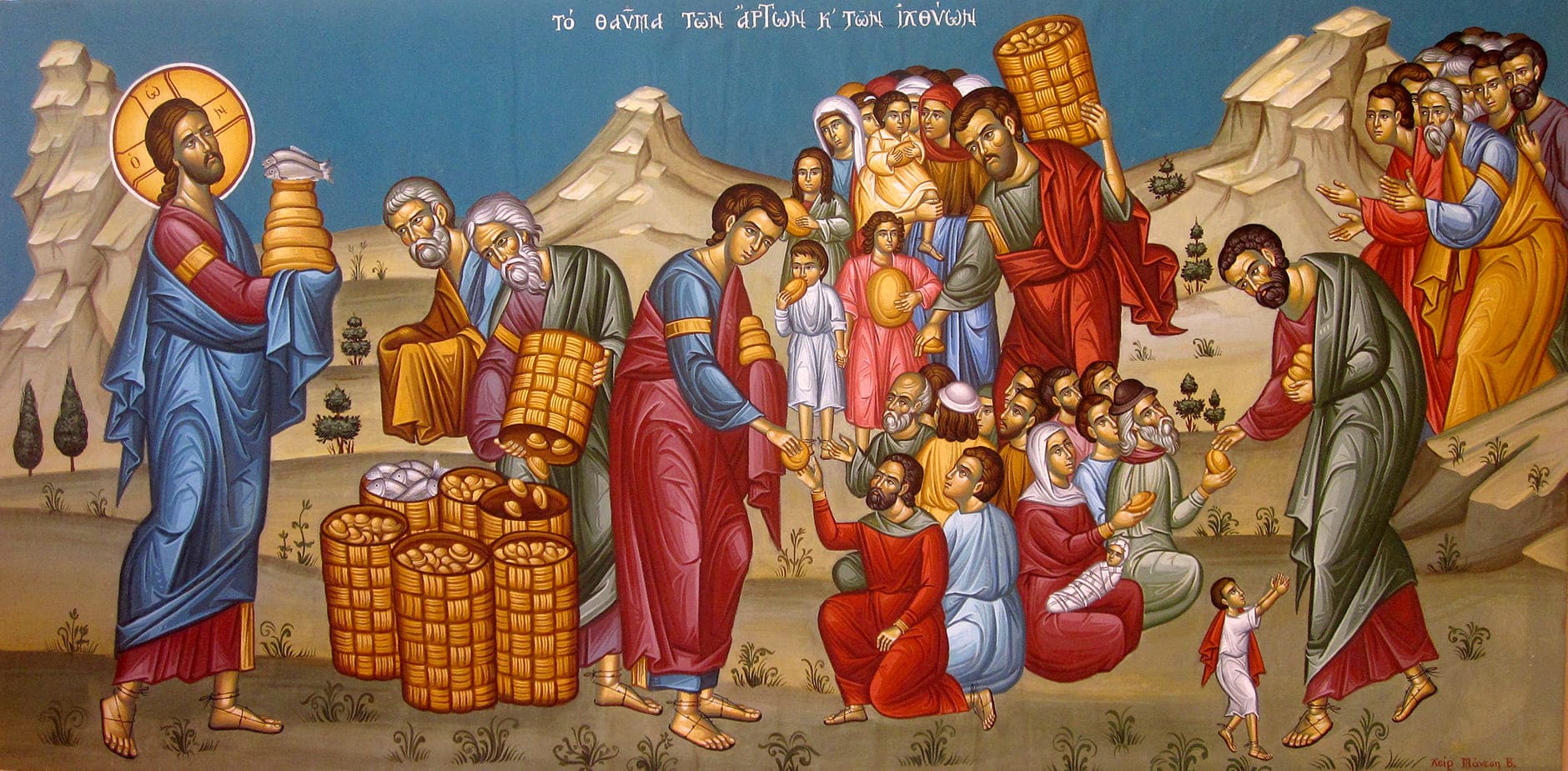
The principle behind a Giving Chain can be understood through one of the most familiar passages in the Gospel.
In the Gospel according to St. John, the Apostle Andrew draws Christ’s attention to a boy carrying a very modest amount of food:
“There is a lad here who has five barley loaves and two small fish, but what are they among so many?” — John 6:9, NKJV
Humanly speaking, the boy’s offering appeared far too small. Yet he gave what he had. Christ received it, gave thanks, and fed the multitude. St. John tells us that about five thousand men were present. The parallel account in St. Matthew adds that this number did not include women and children.
This event is known as the Feeding of the Five Thousand. It reveals a profound Christian truth: no sincere offering is insignificant when it is placed in God’s hands and joined with the faith and participation of others.
A Giving Chain does not attempt to reproduce or mathematically explain a divine miracle. It takes its inspiration from the same spiritual principle. One person offers a small gift. Others respond and add their own. With God’s help, many modest contributions can become one great work.
How One Gift Becomes a Growing Chain
The Giving Chain works through one simple, repeatable action.
One person makes a donation and invites three people. If those three people give and each invites three more, the chain grows from one participant to three, then to nine, twenty-seven, and eighty-one:
1 → 3 → 9 → 27 → 81
This is geometric growth. No participant is expected to find hundreds of donors. Each person takes only one manageable step: gives according to his or her ability and personally invites three other people.
If a parish chooses five invitations instead, the theoretical progression is even faster:
1 → 5 → 25 → 125 → 625
Real campaigns will not follow either progression perfectly. Some recipients will not open the invitation. Others may visit the page but decide not to give. Some will participate after the suggested response period. That is normal.
Levels
15
Donors
90
Average gift
$24.65
Entire chain total
$2,218.90
- Organizer
- Invited
- Visited
- Donated
- Expired
The Giving Chain does not require perfect participation. If even part of each group continues, new branches appear, the network widens, and the campaign keeps moving forward. Its strength comes not from one person reaching a vast audience, but from many people opening the door to their own small circles of trust.
This is the central idea of the Giving Chain Challenge:
Give. Invite. Keep It Growing.
Why the Giving Chain Can Be Effective
Most people receive many general appeals for support. A personal invitation from a friend, relative, neighbor, or fellow parishioner is different. It immediately answers an important question: Why are you asking me?
The invitation comes from someone the recipient knows. It carries a personal story, a visible purpose, and a clear next step. Instead of being asked simply to donate, the recipient is invited to become part of something already growing.
The platform makes that growth visible. Each participant can see not only his or her own contribution but also the donations made by people who subsequently join the same branch.
A gift of $25 may become the beginning of a branch that eventually raises hundreds or thousands of dollars. No particular result is promised. The chain simply shows how one act of generosity can inspire another.
The Giving Chain also creates a natural sense of momentum. Invitations have a response period—72 hours by default. The deadline is not intended to pressure or embarrass anyone. It simply helps people respond while the request is still fresh.
Finally, the visual diagram gives the campaign a human shape. Donations are no longer isolated transactions on a payment report. They become a living network of people supporting one common purpose.
How a Parish Launches a Giving Chain
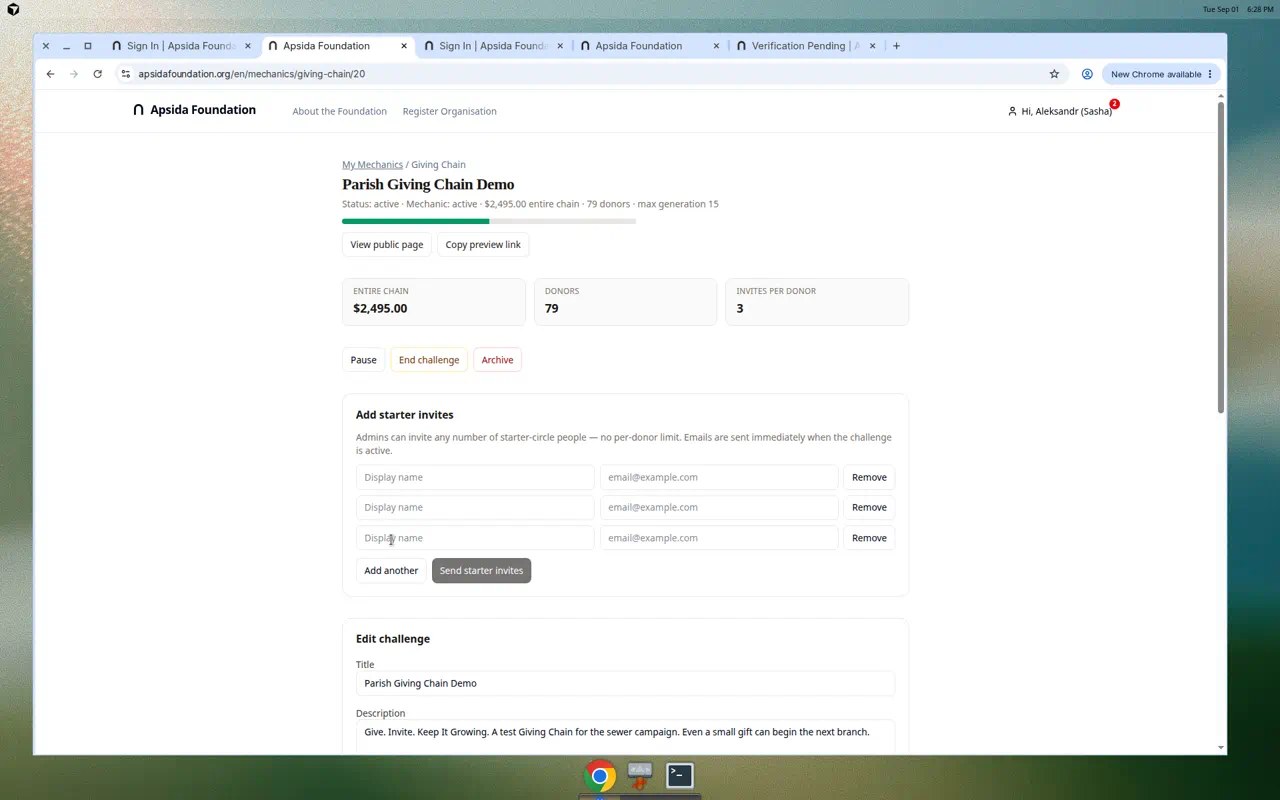
A parish begins with an existing fundraising campaign. The administrator opens the campaign, selects Giving Chain, and enters a clear title and a short explanation of the need.
The purpose should be specific. “Support our parish” is sincere but too broad. “Help us replace the church roof before winter,” “Help us build an accessibility ramp,” or “Help complete the new parish hall” gives people a concrete reason to act.
The administrator then chooses whether each participant may invite three or five people. Three is usually the better choice for a focused personal appeal. Five may work well for a larger, highly connected community.
The parish also selects the response period. The default is 72 hours, although the administrator may choose another interval. The platform then prepares the campaign page, invitation text, social-sharing tools, and visual chain.
Before the public launch, the parish should assemble a small Starter Circle. These are dependable people who agree in advance to make the first donations and send the first invitations.
A good Starter Circle should include people from different parts of parish life: parents, young adults, choir members, longtime parishioners, converts, local business owners, neighbors, and friends of the community. Each participant opens a different door.
What the Participant Does
A participant opens the Giving Chain page and makes a donation of any permitted amount. There is no required contribution beyond the platform’s standard minimum, and a larger gift does not grant additional privileges.
After the donation is confirmed, the platform creates a personal Giving Chain page for that participant. The page shows four central figures:
My Donation is the amount personally given by the participant.
Given After Me is the total donated by everyone who later joins the participant’s branch.
My Branch Total combines the participant’s gift with all subsequent gifts in that branch.
Entire Giving Chain is the amount raised through all branches of the challenge.
The participant then enters the names and email addresses of three or five people. The platform sends each recipient a personal message containing a secure invitation link.
The participant may also share the personal page through social media. The platform generates a branded image with the current branch total displayed prominently. As additional donations enter the branch, the number grows and the sharing image is updated.
This creates a natural reason to share the page again. The participant is not merely repeating the same request. There is new progress to report.
What the Invited Person Sees
When a recipient follows the personal link, the page explains the parish’s goal, identifies the person who sent the invitation when permission has been given, and shows the current total of that branch.
The recipient may give any appropriate amount. After the payment is confirmed, that person becomes a new participant, receives a personal page, and may invite the next group.
Each successful donation appears as a green node in the visual tree. A pending invitation appears in gray. A visited link has a black outline. If the response period ends without a donation, the node becomes red.
Ready to begin?
Opens the setup wizard. Sign in first if you are not already logged in. Organization admins can launch the campaign; members are guided to register or request admin access.